
A wardrobe's handle is the one part of it you touch every single day. It's also, oddly, the last thing most people think about — picked in five minutes from a supplier catalogue after weeks spent choosing the door finish. This guide is our honest walk through how handles actually work: the profiles, the fixings, the finishes that age well versus the ones that show every fingerprint, and how to specify handles that suit the room rather than just matching the door colour.
Handles seem simple until you're standing in a showroom holding four near-identical bar profiles, unsure which one will actually feel right at 3mm, 5mm or 8mm thick, in your hand, every morning for the next fifteen years. Below is the guide we actually give clients — not a product list, but the reasoning behind it.
Push-catch travel, cycle ratings, door-thickness compatibility and where handleless genuinely works — the technical detail behind Section 2.
Read the spec → Deep DiveFull fixing-centre chart, screw-length by door thickness, and a side-by-side finish durability comparison — the reference sheet our own fitters use on site.
Read the guide →Every wardrobe handle on the market is a variation on four basic profiles. Rather than a photo gallery, here's each one drawn to true relative proportion, with the honest case for and against.
The default for a reason: a straight bar, fixed at two points, sitting proud of the door by 20–30mm. Available from 96mm centres (a small drawer) up past 640mm for a full-height larder door. It reads modern in brushed steel, softer in matte black, almost Shaker-adjacent in an aged brass.
Slab and shaker doors, kitchens-adjacent utility rooms, anywhere you want a confident, grabbable handle that a child or an arthritic hand can use without thinking.
Very narrow drawer fronts (under 250mm) where a long bar looks oversized, and low-lit dressing rooms where a proud bar catches on clothing being carried past.
A single-point fixing, usually 28–40mm in diameter, in mushroom, ball or cone form. The traditional choice for period and Shaker-style furniture, and the only profile that genuinely disappears into a busy pattern of doors — a wall of 12 wardrobe doors with knobs reads far calmer than the same wall with bars.
Shaker and framed doors, traditional and country-style schemes, anywhere you want the handle to be felt rather than seen.
Doors you open with a full hand rather than fingertips — tall larder or wardrobe doors are genuinely harder to pull open on a single knob than a bar, especially for anyone with reduced grip strength.
A groove or aluminium profile machined or fixed into the top or side edge of the door itself — no separate hardware standing proud of the face. Not fully handleless (see below) but close: from a few feet away the door front reads flat and unbroken.
Slab doors in a minimalist scheme, small rooms where every millimetre of clearance matters, matt lacquer finishes that would otherwise show every bar-handle fingerprint.
Requires the door to be routed at manufacture — not something you retrofit onto an existing slab door without replacing the front.
A shaped channel cut into the door face or top edge that your fingers hook into — genuinely handleless, nothing added, nothing protruding. The cleanest possible line, and the option most often specified alongside push-to-open hinges so there's no visible hardware at all.
Contemporary handleless schemes, media walls and wardrobe fronts that need to visually disappear into a wall of panelling.
Shows dust and lint faster than any other profile because the groove itself collects it — ask about a self-clean lacquer finish if specifying this for a dressing room.
Roughly a third of the wardrobes we design now specify a fully handleless front — not because handles are unfashionable, but because push-to-open hardware has genuinely improved. A quality push-catch mechanism (we spec Blum or equivalent) needs about 4–5mm of forward travel before it releases, and it's rated for tens of thousands of cycles, so it doesn't loosen or start double-bouncing after eighteen months the way budget mechanisms do.
The trade-off is entirely practical, not aesthetic: a push-catch door needs a firm, deliberate push, which is harder for young children, anyone with reduced grip or dexterity, or simply anyone with wet or full hands. We routinely mix approaches within a single room — push-to-open on upper cabinets that are opened occasionally, a proper handle on the daily-use hanging doors at reach height.
"Centres" is the distance between a bar handle's two fixing screws, and it's the single most common reason a client's own-bought handles don't fit when they arrive on site. Standard sizes step in fixed increments — 96mm, 128mm, 160mm, 192mm, 224mm, 256mm, 320mm and upward — and a door that's already been drilled to one centre size cannot take a handle drilled to a different one without patching and refinishing the door face.
If you're replacing handles on an existing wardrobe rather than specifying a new one, measure your current centres before you order anything: screw-to-screw, not end-to-end of the handle itself. Two handles that look identical in a catalogue photo can be drilled 32mm apart in centre spacing.
| Door / Drawer Width | Typical Centres | Common Use |
|---|---|---|
| Small drawer, under 300mm | 96mm – 128mm | Jewellery drawers, small internal drawers |
| Standard drawer, 300–450mm | 160mm – 224mm | Wardrobe drawer fronts |
| Standard door, 450–600mm | 224mm – 320mm | Single wardrobe doors |
| Tall / larder door, 600mm+ | 320mm – 640mm+ | Full-height wardrobe and larder-style doors |
Polished chrome and gloss-black handles look immaculate in a showroom under even lighting, and show every single fingerprint within a day of daily use at home. This isn't a manufacturing fault — it's physics, and it's worth knowing before you commit a whole room to a high-shine finish.
Sharpest, most reflective finish. Shows fingerprints and water spots readily — needs a quick wipe to stay looking its best. Best in low-touch areas or where you don't mind the maintenance.
The practical default. The brushed texture disguises fingerprints almost entirely and hides light scratches over years of use. Our most-specified finish for daily-use wardrobe doors.
Strong graphic contrast against light doors, but a true matte powder-coat can show oily fingerprints as a slight sheen over time. Ask specifically for a "fingerprint-resistant" matte coat, not just "matte black" — the difference matters.
A "living" finish is meant to patina and darken with handling — if specified this way, fingerprints become part of the character, not a flaw. Confirm with your supplier whether the brass is lacquered (stays bright, needs no maintenance) or living (patinas, needs none either, but looks different).
Every handle in a continuous run of wardrobe doors should sit at the same height off the floor, measured to the same point on the handle — not "roughly the same," exactly the same. A 10mm inconsistency is invisible in a single photo and obvious the moment you stand in the room.
Handle finish should be chosen against an actual sample of the door colour, in the room's real lighting — not from a supplier's catalogue photo. Warm LED lighting shifts how brushed steel and brass both read.
A 96mm knob-style handle on a 900mm-wide larder door looks and feels undersized — proportion the handle length or knob diameter to roughly a third of the door's shorter dimension as a starting point.
If specifying push-to-open across an entire wardrobe wall, keep at least one daily-use door on a conventional handle for anyone in the household who struggles with the push mechanism — children, guests, ageing parents.
Fixing screw length depends on door thickness (usually 18mm or 22mm for wardrobe fronts) — a handle ordered with the wrong screw length either doesn't reach the thread or protrudes through the back face. We confirm this on every order before it's placed.
Usually yes, provided the new handle's fixing centres match the existing drill holes exactly, or are wider (a longer bar can cover old holes; a shorter one can't hide them). If you're changing centres, the door front will need patching and refinishing at the old fixing points, which is a job worth costing before you commit to a specific handle.
Budget mechanisms can, typically starting to "double-bounce" (push once, door doesn't release, push again) after a year or two of daily use. A quality mechanism rated for 60,000+ cycles should comfortably outlast the wardrobe itself. It's a false economy to save a few pounds per door on the catch mechanism.
Brushed or satin steel, consistently, across every finished room we've fitted. The textured surface hides both fingerprints and the light surface scratches that accumulate from keys, rings and daily contact — polished and gloss finishes show both far more readily.
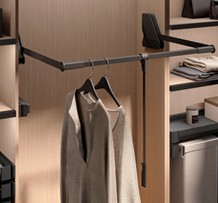
Not necessarily matched exactly, but they should be deliberately coordinated. A common approach is matching handles to visible hardware (drawer runners, wardrobe lift mechanisms) while letting concealed hinges be whatever finish is standard — nobody sees a hinge once the door's hung.
Sometimes marginally, but the risk is a centres mismatch with pre-drilled doors, or a screw length that doesn't suit your door thickness. If buying independently, get your door specification (thickness and fixing centres) confirmed in writing first.









 GET QUOTE