











 GET QUOTE
Home / Editorial / The Hidden Risks of Hiring a "Man and Van" Wardrobe Fitter (And What to Check Before You Pay a Deposit)
28 Aug 2026
The Hidden Risks of Hiring a "Man and Van" Wardrobe Fitter (And What to Check Before You Pay a Deposit)
Two quotes land in your inbox for the same fitted wardrobe. One is from a showroom-based company. The other is roughly half the price, from someone who found you through a local Facebook group and works alone out of a van. It's tempting — a lot of money sits between those two numbers.
Two quotes land in your inbox for the same fitted wardrobe. One is from a showroom-based company. The other is roughly half the price, from someone who found you through a local Facebook group and works alone out of a van. It's tempting — a lot of money sits between those two numbers.
But a quote is only half the information you need. The other half is what's not written on it: whether the person turning up to drill into your bedroom walls is insured, whether there's anyone to call if the wardrobe doesn't sit flush against an uneven wall, and whether your deposit is protected by anything more than good faith.
This isn't an argument against sole traders as a category — plenty are skilled, honest, and worth every penny. It's a guide to the specific things a "man and van" pricing structure often can't include, so you can make an informed choice rather than a hopeful one.
Why a Low Quote Isn't the Same as Good Value
A quote tells you a number. It doesn't tell you what's inside that number — or what's been left out of it to get the price down. Before comparing two prices, it's worth understanding what a wardrobe installation actually involves: a site survey, a design that accounts for your room's quirks, materials and hardware of a known quality, the labour itself, and — crucially — what happens after the fitter leaves.
A company with a showroom, a design team, and an office has to price all of that in. A one-person operation working from a van has lower overheads, and a lower price can genuinely reflect that. But it can also reflect corners being cut in ways you won't discover until after you've paid: no insurance, no formal guarantee, no aftercare route, and no one to hold accountable if something goes wrong.
The rest of this guide walks through exactly what to check before you commit — starting with the thing most buyers never think to ask about.
The Showroom Problem: Why "You Can't See It Before You Buy It" Matters
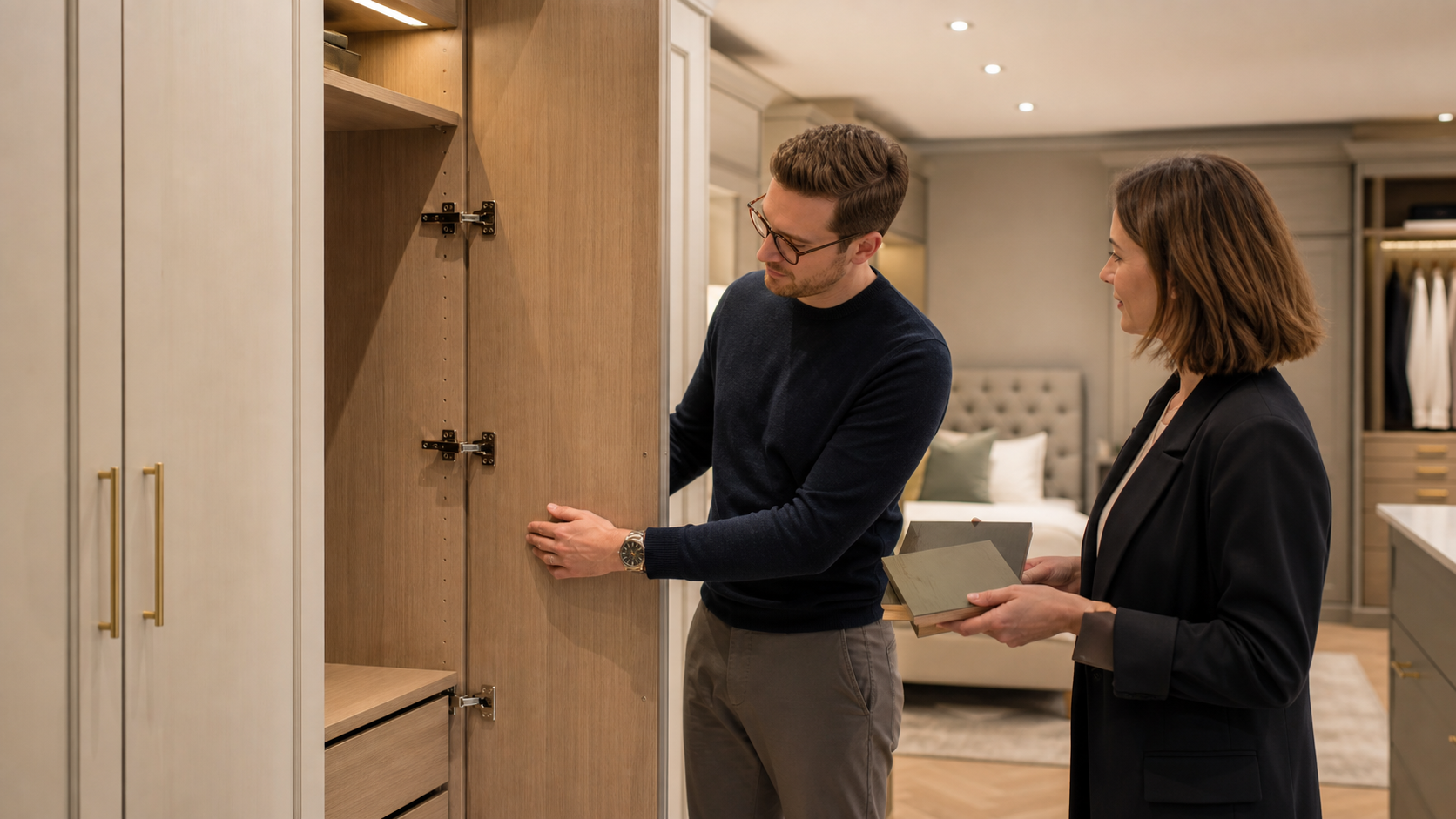
If a fitter doesn't have a showroom, you're choosing your wardrobe's finish, hardware, and construction quality from photographs — or worse, from a supplier's stock catalogue image that may not match what actually turns up.
A physical showroom lets you check things a photo can't show:
- Door weight and feel. A high-gloss door should feel dense and solid, not light and hollow.
- Soft-close action. Hinges and runners should close smoothly and quietly under their own weight — cheap mechanisms often don't.
- Finish under real light. Colours and textures look different under a shop's LED strip lighting than they do in a phone photo taken in someone's spare room.
- Drawer runners under load. A runner that feels fine empty can behave very differently once it's holding folded clothes for a few years.
None of this is a small thing. A wardrobe is a piece of furniture you'll open and close daily for a decade or more. Being able to physically handle the materials before you commit is not a luxury add-on — it's basic due diligence that a showroom makes possible and a van-based operation structurally cannot offer.
The Insurance Question Almost Nobody Asks
Here's the question that catches most people out: is the person fitting your wardrobe covered by public liability insurance?
Public liability insurance covers two things that matter enormously in a domestic fitting job — damage to your property (a drill through a hidden pipe, a dropped panel that chips your flooring, a scratched wall) and injury to anyone on site, including you. Without it, if something goes wrong, you are the one left covering the cost, because there's no policy to claim against.
This isn't a hypothetical risk. Industry insurance research into the UK's self-employed workforce has found that a striking proportion of sole traders carry no business insurance at all — a well-documented gap that many customers simply never think to check for, because trades work is one of the few services people hire without asking for proof of cover first.
There's no law forcing a sole trader to hold public liability insurance for domestic work. It's entirely down to the customer to ask — and a professional operation should have no hesitation producing a current policy document on request. If a fitter is evasive, vague, or tells you "it's fine, nothing's ever gone wrong," that's the moment to pause, not proceed.
A simple way to ask: "Could you send me a copy of your current public liability insurance certificate before we confirm the job?" A legitimate business will have this ready in minutes.
What Happens When Something Goes Wrong
Even good fitters occasionally leave a job that needs a follow-up visit — a hinge that needs adjusting, a panel that's shifted slightly after a few weeks, a drawer that's started to catch. The real difference between a company and a lone operator isn't whether this ever happens. It's what happens next.
With a single-person business, there's no backup. If that person is on another job, unwell, has taken on work in a different part of the country, or has simply stopped trading, there is no one else to call. Your only recourse is the same personal mobile number that may or may not be answered.
With a company, aftercare is a process, not a favour — a documented guarantee, a support line, and a team structure that doesn't depend on one individual's availability.
This gap between the two models is exactly why consumer complaint bodies in the UK continue to log tens of thousands of home improvement disputes every year, a significant share of which relate to work that was never properly finished or fixed after initial installation. Aftercare isn't a nice-to-have line on a brochure — it's the difference between a wardrobe that gets fixed in a week and one that never does.
Permits, Trade Bodies and Paperwork Worth Checking
Beyond insurance, a short paper trail tells you a lot about who you're dealing with:
- Company registration. Is this a registered business (checkable on Companies House) or an individual trading informally under a personal name?
- Trade body membership. Bodies like the Federation of Master Builders or equivalent furniture-trade associations vet members against basic standards — membership isn't proof of perfection, but it's a real, checkable credential.
- A written quote, not a verbal one. Anything agreed only by text message or a phone call is much harder to hold anyone to if a dispute arises later.
- Reviews tied to a real business, not just a handful of testimonials with no way to verify who wrote them.
None of these checks take long, and a legitimate operation — whether a sole trader or a company — should be able to satisfy every one of them without friction.
What a Showroom-Backed Company Does Differently
At Xeeni, this isn't a hypothetical comparison — it's the model the business is built around. A physical West London showroom means you can handle finishes and hardware before you commit. A free design service means your wardrobe is planned around your actual room, not guessed at from a phone call. Every installation is backed by a documented guarantee, and aftercare is handled by a team, not a single mobile number that may or may not be picked up.
None of that makes a sole trader automatically the wrong choice. It does mean the burden of checking — insurance, aftercare, accountability — shifts from the customer to the business itself, which is where it belongs.
Ready to see finishes and hardware in person?
Book a free design consultation at our West London showroom.
Book a free design consultation at our West London showroom.
A Practical Checklist Before You Pay Any Deposit
Save or screenshot this before you agree to any fitted wardrobe quote:
- Ask for proof of current public liability insurance — in writing, not a verbal assurance.
- Confirm whether the business is a registered company or a sole individual.
- Ask to see finished examples in person, not just photos — a showroom visit or a genuine site visit to a previous customer.
- Get the quote, specification, and guarantee terms in writing before paying anything.
- Ask exactly what the guarantee covers, and for how long.
- Ask what happens — specifically — if you need a follow-up visit after installation.
- Never pay the full amount upfront; agree a staged payment schedule tied to milestones.
If any of these seven checks are met with resistance, vagueness, or pressure to "just pay now," treat that as the answer.
FAQ
Is it illegal for a sole trader to work without public liability insurance?
No — there's no general legal requirement for a sole trader to hold public liability insurance for domestic work. It's a business choice, which is exactly why it's on the customer to ask for proof rather than assume it exists.
How can I check if a fitter is insured before they start work?
Ask directly for a copy of their current public liability insurance certificate. A legitimate business can produce this immediately; hesitation or vague reassurance is a warning sign worth taking seriously.
What should I do if a fitter takes a deposit and stops responding?
Keep all communication in writing to create a paper trail, check whether they're a registered company via Companies House, and contact Citizens Advice or Trading Standards for guidance on next steps. Registered businesses can typically be pursued through the small claims process; unregistered individuals are much harder to trace.
Are sole-trader fitters always worse than a company?
No — many sole traders are highly skilled and entirely trustworthy. The point isn't to avoid them on principle, but to verify the same things you'd expect from any tradesperson: insurance, a written agreement, and a clear answer for what happens if something needs fixing afterwards.
Does a showroom visit actually change the outcome of my wardrobe?
Yes, in practical terms — being able to check door weight, hinge action, and finish colour under real light before committing reduces the chance of a mismatch between what you expected and what arrives.